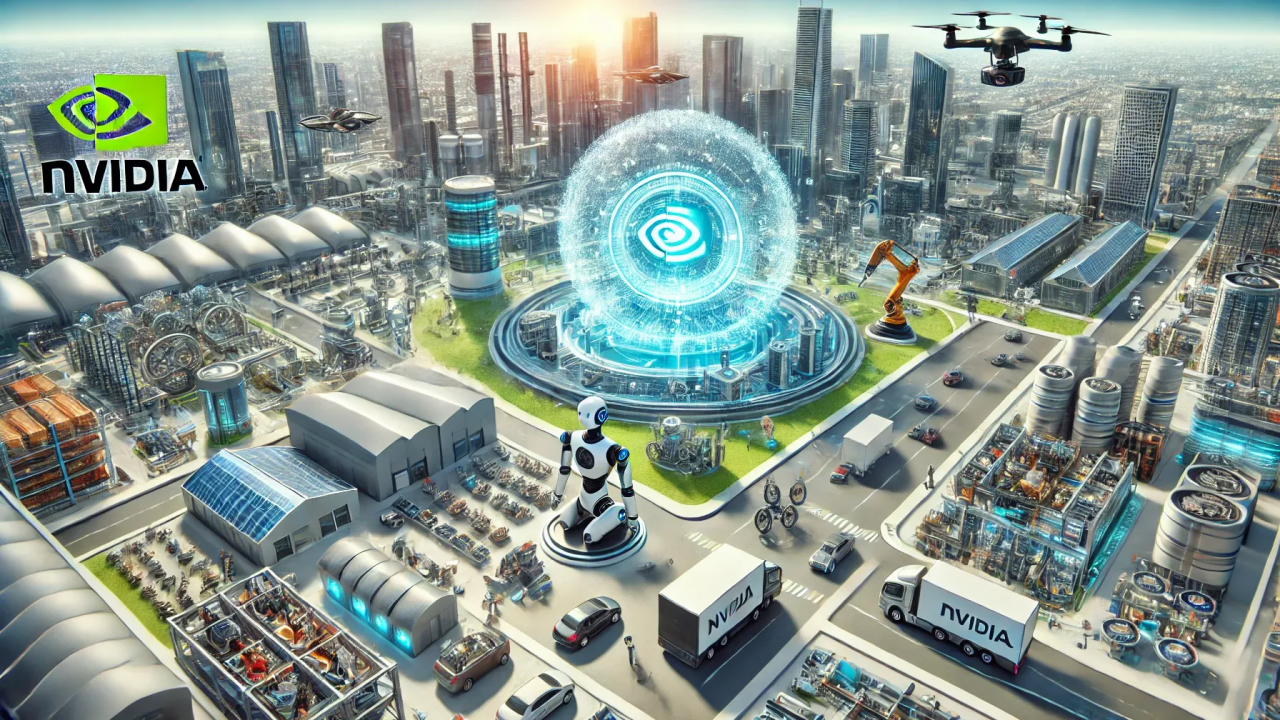
Nvidia physical AI ambitions are quietly reshaping the company’s long-term growth story. While most investors still view Nvidia primarily as the world’s leading AI chipmaker, the company is steadily building a broader ecosystem that extends far beyond graphics processing units. That shift could redefine how markets value Nvidia in the coming years.
With U.S. firms projected to spend more than $650 billion on capital expenditures tied to AI infrastructure, Nvidia remains at the center of the current boom. However, the company is increasingly positioning itself not just as a hardware supplier, but as a full-stack platform powering the next wave of robotics and real-world AI systems.
Nvidia Physical AI Strategy Moves Into Robotics
The Nvidia physical AI roadmap includes robotics platforms such as GR00T and Jetson Thor, signaling a major push into embodied AI systems. These platforms are designed to power humanoid robots and industrial machines capable of learning, adapting, and operating in physical environments.
GR00T serves as a foundational model for humanoid robots, acting as a brain that enables machines to understand and interact with the world. Meanwhile, Jetson Thor provides the computing backbone needed to process AI workloads directly within physical devices. Together, these technologies aim to support what many describe as the coming robotics revolution.
In addition, Nvidia’s digital twin technology allows companies to simulate real-world environments before deploying AI systems into actual machines. This approach reduces risk, improves efficiency, and accelerates development cycles. As robotics adoption expands, Nvidia physical AI platforms could become essential infrastructure.
China Market Reopening Adds Growth Potential
Nvidia recently received approval to resume certain chip sales into China, providing another potential catalyst. Although expectations for near-term Chinese growth remain measured, long-term demand in the region represents a significant wildcard.
As global AI infrastructure buildouts accelerate, access to the Chinese market could provide incremental revenue streams. Combined with expanding partnerships across major technology firms, Nvidia’s growth profile remains strong even as investor sentiment enters a more cautious phase.
Valuation Enters a “Show-Me” Stage
Despite continued revenue momentum, Nvidia shares have traded sideways in recent months. The stock currently trades at roughly 45 times trailing earnings, a valuation that reflects high expectations but also recognizes the need for tangible returns on massive AI spending.
Investors are increasingly asking whether hundreds of billions in AI capital expenditures will generate sustainable returns. While the broader market seeks proof, Nvidia physical AI investments may represent an underappreciated growth lever.
Beyond Chips: A Platform Company in the Making
Nvidia is evolving from a semiconductor leader into a platform company. Similar to how other technology giants have expanded beyond their original products, Nvidia is building an ecosystem that integrates hardware, software, simulation, and robotics.
This transformation positions the company at the forefront of both digital and physical AI innovation. If robotics and embodied AI scale over the next several years, Nvidia could benefit not only from chip sales but also from platform dominance.
As the AI narrative shifts from pure infrastructure buildout to real-world deployment, Nvidia physical AI initiatives may play a larger role in shaping the company’s next phase of growth.