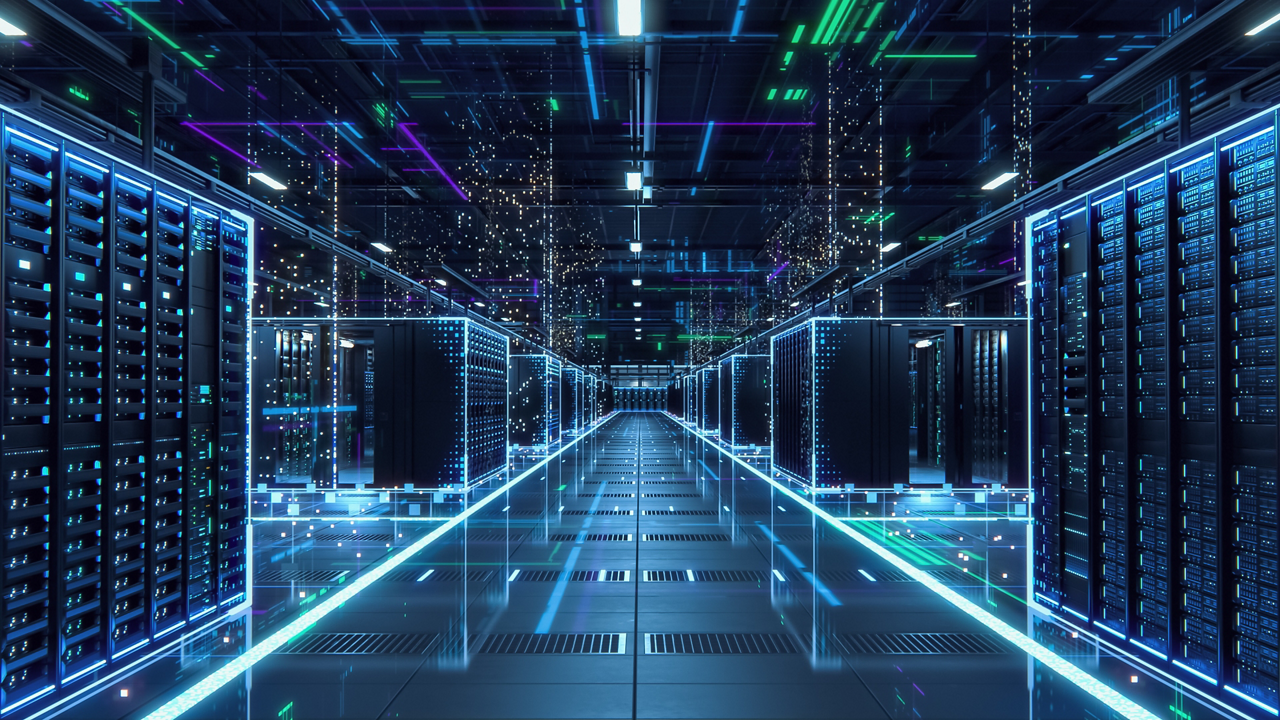
AI data centers are becoming one of the biggest growth areas in technology as companies race to build the infrastructure needed for artificial intelligence.
ABB has expanded its partnership with Nvidia to support faster and smarter deployment of AI infrastructure. The collaboration focuses on helping data center operators design, test and optimize power distribution systems in a digital environment before construction begins.
The move comes as AI workloads demand more power, better cooling, faster computing and stronger infrastructure planning. For companies building the next generation of data centers, digital modelling is becoming an important way to reduce risk, improve efficiency and speed up deployment.
How AI data centers will benefit from ABB and Nvidia
The expanded partnership will bring ABB’s power systems into Nvidia’s Omniverse DSX Blueprint as SimReady 3D digital assets.
This means data center operators can model electrical systems digitally before physical construction starts. They can also validate power distribution, thermal performance and compute requirements within one connected environment.
For AI data centers, this is a major step. These facilities are more complex than traditional data centers because they must support heavy AI workloads, high-performance chips and large-scale computing clusters.
By using digital simulation, operators can identify design problems earlier. They can test different power layouts, check thermal limits and improve system performance before committing to expensive construction decisions.
Why power systems matter in AI data centers
AI data centers need huge amounts of electricity. Advanced AI chips and servers consume significant power, especially when used for training and running large models.
This makes power distribution one of the most important parts of AI infrastructure. If the electrical system is not designed properly, a data center may face inefficiency, downtime, overheating or higher operating costs.
ABB’s role in the partnership is important because the company specializes in electrification and power systems. Nvidia brings the digital platform and AI infrastructure ecosystem. Together, the two companies are trying to help operators plan facilities that can handle future AI demand.
The goal is not only to build more data centers. It is to build them better.
Nvidia Omniverse supports digital data center planning
Nvidia’s Omniverse DSX Blueprint is designed to help teams create digital versions of data center environments.
With ABB’s power systems integrated into the platform, operators can create more realistic simulations of how electrical infrastructure will perform. This helps engineers, developers and facility managers make better decisions before construction begins.
Digital twins and 3D simulation tools are becoming more important because data centers are expensive to build. A mistake in the design stage can lead to delays, cost overruns and performance problems.
For AI data centers, the margin for error is even smaller. These facilities must meet demanding requirements for power, cooling, networking and computing performance.
ABB and Nvidia build on earlier collaboration
The latest announcement builds on an earlier partnership between ABB and Nvidia focused on a new power architecture for AI data centers.
That earlier work aimed to address the growing pressure placed on electrical systems by advanced AI workloads. The new phase goes further by connecting ABB’s electrical distribution technology with Nvidia’s digital ecosystem.
This gives data center teams a more integrated way to plan infrastructure. Instead of working with separate models for power, cooling and computing, operators can validate these systems in a unified digital environment.
That could make the construction process faster, more accurate and more efficient.
AI chip demand lifts infrastructure stocks
The ABB and Nvidia partnership comes during a strong period for AI-related infrastructure companies.
Nvidia remains one of the most closely watched companies in the AI chip market. The company’s shares recently closed at $222.82, down 0.7%, according to the market update.
Marvell Technology was one of the biggest movers, rising 32.5% to close at $290.79. The stock traded near its 52-week high after the company introduced the Teralynx T100, an AI-optimized switch silicon product designed for low power consumption and low latency.
That move shows how investors are paying close attention to companies that support AI data centers beyond the chip itself. Networking, switching, memory, storage and power systems are now central parts of the AI infrastructure story.
Broadcom, Micron and AMD gain attention
Several other AI chip and infrastructure names also attracted investor interest.
Broadcom closed at $481.57, up 4.7%, and traded near its 52-week high. The company recently showcased its broadband Edge AI portfolio, including Wi-Fi 8 solutions and a 50G PON gateway for connected AI applications.
Micron Technology closed at $1,064.10, up 2.8%, also near its 52-week high. The company highlighted AI-optimized memory and storage products at Computex 2026, including high-bandwidth memory, data center SSDs and energy-efficient DRAM technologies.
Advanced Micro Devices closed at $521.54, up 2.2%, near its 52-week high. AMD also showcased its next-generation Helios rack-scale platform at Computex, focusing on scalability and performance for AI workloads.
Together, these moves show that the AI infrastructure rally is spreading across the broader semiconductor and data center supply chain.
Why AI data centers are reshaping the chip market
The growth of AI data centers is changing what investors look for in technology companies.
In the past, the market focused mainly on processors and graphics chips. Today, investors are also watching networking chips, memory, storage, cooling systems, power distribution and digital infrastructure software.
AI workloads require all these systems to work together. A powerful chip alone is not enough if the data center cannot deliver enough power, move data quickly or keep systems cool.
That is why companies such as ABB, Nvidia, Marvell, Broadcom, Micron and AMD are becoming part of the same larger story.
The AI boom is no longer only about chips. It is about the full infrastructure stack.
What the ABB and Nvidia deal means for operators
For data center operators, the expanded ABB and Nvidia partnership could help reduce uncertainty.
Planning an AI-ready facility is difficult. Operators must balance power capacity, heat management, server density, equipment costs and future expansion needs.
Digital modelling can help teams test these decisions before construction starts. It can also support faster communication between engineers, developers and technology partners.
If the tools work as intended, operators may be able to reduce design errors, improve energy efficiency and bring AI infrastructure online more quickly.
That matters because demand for AI computing capacity continues to rise.
AI data centers face power and efficiency challenges
Despite the excitement, AI data centers also face major challenges.
Power demand is one of the biggest. As more companies deploy AI models, electricity use is expected to rise sharply. This could place pressure on grids, increase operating costs and raise environmental concerns.
Efficiency will therefore become a key competitive advantage. Companies that can design smarter, more reliable and more energy-conscious facilities may have a stronger position in the market.
The ABB and Nvidia partnership addresses this challenge by focusing on power modelling and system optimization before construction.
That approach could become more common as AI infrastructure becomes larger and more expensive.
The future of AI data centers
AI data centers are likely to remain a major investment theme as artificial intelligence becomes more widely used in business, research, healthcare, finance, manufacturing and consumer technology.
The next phase of growth will require more than powerful chips. It will require better planning, stronger power systems, efficient cooling, faster networking and smarter digital design tools.
ABB and Nvidia’s expanded collaboration reflects this shift. It shows that the companies building AI infrastructure are now focusing on the full lifecycle of data center development, from digital design to real-world deployment.
For investors, the message is also clear. The AI boom is creating opportunities across the technology supply chain, not only in chipmakers but also in the companies that provide the systems behind them.
The bottom line
AI data centers are driving a new wave of collaboration between technology and infrastructure companies.
ABB and Nvidia’s expanded partnership aims to make AI infrastructure easier to design, validate and deploy by using digital power system modelling inside Nvidia’s Omniverse DSX Blueprint.
As AI workloads grow, data centers will need stronger power systems, better planning and more efficient deployment. That makes partnerships like this important for the next stage of the AI infrastructure boom.
The race to build AI capacity is not slowing down. But the winners may be the companies that can make AI data centers faster, smarter and more reliable.