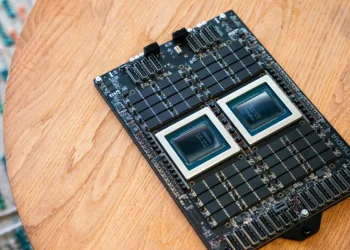
President Donald Trump has allowed Nvidia to sell its H200 AI chips to “approved customers” in China. The policy also covers other U.S. chipmakers like AMD. On Monday, Trump said this move would protect national security, create American jobs, and keep U.S. AI leadership strong.
This decision reverses earlier export bans. The U.S. had blocked Nvidia from selling top-tier chips to China over military concerns. Then in July, Trump eased restrictions—but demanded Nvidia pay 15% of its China revenue to the U.S. government.
Now, the H200 chip can go to commercial buyers vetted by the Commerce Department. Nvidia welcomed the change. “This strikes a thoughtful balance that is great for America,” the company said. Its stock rose slightly after the announcement.
The shift follows intense lobbying by CEO Jensen Huang. He visited Washington last week to push for more flexible rules. Huang has long argued that AI technology should be accessible worldwide—including in China.
Moreover, he warns that China is catching up fast in chip development. Beijing has built its own semiconductor industry. In fact, it previously told tech firms to avoid Nvidia’s older H20 chips and use domestic ones instead.
Still, the H200 offers real value to China’s tech sector. “It buys time for the U.S. to negotiate with Beijing,” said Alex Capri of the National University of Singapore. Rare earth minerals are key here. China controls most of the world’s processing capacity for these materials, which are essential for electronics.
However, national security risks remain. Experts at Georgetown’s CSET say China’s military already uses U.S. chips to build AI systems. “Easier access helps China deploy AI for battlefield advantage,” warned analyst Cole McFaul.
Trump’s post also mentioned a “$25%” payment to the U.S.—a figure that conflicts with the earlier 15% rate. The White House has not clarified this. The policy will likely face opposition from security-focused lawmakers.
For now, only commercial buyers can get the H200. It is one generation behind Nvidia’s top Blackwell chip, which stays banned. Yet critics say even commercial chips can speed up military AI work.
Ultimately, this move tries to balance competing goals. Allowing limited Nvidia chips for China supports U.S. industry and jobs. At the same time, it risks strengthening China’s AI capabilities—civilian and military.
As tensions continue, the line between trade and security grows thinner. The world will watch how this high-stakes strategy unfolds.