NVIDIA has announced a groundbreaking partnership with Mistral AI to accelerate the development and deployment of a new family of open-source multilingual, multimodal models known as the Mistral 3 family. These new models are optimized for NVIDIA platforms, including supercomputing systems and edge devices, marking a significant step towards distributed intelligence that spans the cloud, data centers, and edge environments. This collaboration aims to empower developers and enterprises to harness the full potential of large-scale AI models with unprecedented efficiency, scalability, and adaptability.
Mistral 3 Family: A Leap Toward Distributed Intelligence
The Mistral 3 family includes models that are optimized for high-performance computing, making them suitable for everything from enterprise AI workloads to smaller-scale edge deployments. One of the key highlights is Mistral Large 3, a mixture-of-experts (MoE) model, which utilizes an efficient architecture by activating only the most impactful parts of the model rather than all neurons for each token. This leads to significant efficiency gains, allowing for better accuracy and lower resource usage without compromising performance.
The Mistral Large 3 model boasts 41 billion active parameters and a 256K context window, making it scalable, efficient, and adaptable for high-demand AI applications. It combines 675 billion total parameters, ensuring that the model is equipped to handle complex tasks while maintaining performance at scale. Whether it’s being run in the cloud, data centers, or on edge platforms, this model’s versatility makes it a game-changer for industries requiring real-time AI insights.
Leveraging NVIDIA Hardware for Superior Performance
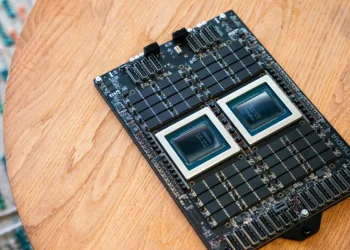
Mistral 3 models are designed to run on NVIDIA’s GB200 NVL72 systems, which provide the perfect infrastructure for parallelism and hardware optimizations. By using NVIDIA NVLink, Mistral AI’s MoE architecture taps into a coherent memory domain, enabling large-scale expert parallelism. This optimization is further enhanced by NVIDIA’s NVFP4 and Dynamo disaggregated inference technologies, ensuring peak performance during large-scale training and inference processes.
On NVIDIA’s GB200 NVL72 system, Mistral Large 3 achieved a 10x performance gain over the previous-generation NVIDIA H200. This generational leap translates into faster AI workflows, a lower per-token cost, and improved energy efficiency. These improvements are expected to deliver better user experiences, especially when deploying AI at scale.
Mistral 3 Models for Edge Devices: Bringing AI Closer to the User
In addition to high-performance models for large-scale enterprise use, Mistral AI has also focused on compact models for edge applications. The Mistral 3 suite includes small language models that are optimized to run on a variety of NVIDIA edge platforms, such as NVIDIA Spark, RTX PCs, laptops, and Jetson devices. This suite allows developers to deploy AI models efficiently and cost-effectively in edge environments, expanding the reach of AI beyond the cloud and into more distributed systems.
NVIDIA has worked with top AI frameworks like Llama.cpp and Ollama to ensure optimal performance across NVIDIA GPUs on the edge. By integrating Mistral 3 models with these frameworks, developers and enthusiasts can experiment and deploy fast and efficient AI solutions directly on their edge devices.
Open-Source Models: Empowering the AI Community
The Mistral 3 family is openly available, empowering researchers, developers, and enterprises worldwide to experiment, customize, and accelerate AI innovation. The open-source nature of these models democratizes access to frontier-level AI technologies, allowing anyone to build upon and tailor the models for their own specific use cases.
Mistral AI has also integrated these models with NVIDIA NeMo tools for AI agent lifecycle development. These tools, including Data Designer, Customizer, Guardrails, and the NeMo Agent Toolkit, allow enterprises to customize Mistral 3 models to suit their needs, enabling a smoother transition from prototype to production.
Additionally, NVIDIA has optimized inference frameworks like TensorRT-LLM, SGLang, and vLLM for the Mistral 3 models, ensuring that AI models perform efficiently across the entire AI lifecycle. This flexibility allows enterprises to achieve efficiency from cloud to edge while meeting the unique demands of their AI workloads.
Availability and Future Deployment
The Mistral 3 family is available on leading open-source platforms and cloud service providers starting today. Additionally, these models will soon be deployable as NVIDIA NIM microservices, making it even easier for enterprises to incorporate advanced AI capabilities into their applications without having to manage complex infrastructure.
As AI continues to evolve, Mistral 3 models are prepared to scale with the growing demands of modern AI applications. With NVIDIA’s infrastructure and Mistral AI’s expertise, the future of distributed intelligence is rapidly approaching, bridging the gap between cutting-edge research breakthroughs and real-world applications.
Shaping the Future of AI with Mistral 3 and NVIDIA
The collaboration between Mistral AI and NVIDIA is a significant leap forward for the AI industry. By optimizing the Mistral 3 models across NVIDIA’s supercomputing platforms and edge devices, the partnership is creating a powerful ecosystem for developers, enterprises, and researchers alike. The Mistral 3 family not only pushes the envelope in terms of AI efficiency and scalability but also empowers the broader AI community to innovate, customize, and deploy cutting-edge AI models with ease.
As the demand for AI continues to grow, this collaboration sets the stage for the next wave of AI-powered innovations, making distributed intelligence a reality for a wide range of applications, from enterprise AI workloads to edge computing and beyond.