Nvidia CEO AI Vision Redefines the Future of Work and Power
Nvidia CEO AI statements this week reveal a dramatic shift in how artificial intelligence will reshape society. As Nvidia crosses a $4 trillion valuation, CEO Jensen Huang outlines a future filled with opportunity and disruption. In an interview with CNN’s Fareed Zakaria, Huang delivers a bold message: the age of AI is here—and it will affect everyone.
How AI Will Transform Every Job Sector
Huang emphasized that AI will change every job. Some will vanish. Others will evolve. “Everybody’s jobs will be affected,” he said. While the transition will be painful for many, Huang believes the net effect will be positive. Productivity will rise, and society may become richer as a result.
The World Economic Forum recently warned that 41% of employers could cut staff by 2030 due to AI. Nvidia itself mandates AI usage internally. Huang even praised efforts by the Trump administration to revive U.S. manufacturing, saying it’s vital for the economy and national stability. He believes that reviving the craft of making things will help non-PhDs access meaningful careers.
This approach mirrors Trump’s “Made in America” push and signals a rare alignment between Silicon Valley and conservative economic nationalism. The Nvidia CEO AI message is clear: America must rebuild to lead.
AI in Medicine, Robotics, and National Power
Beyond labor, Huang envisions AI solving humanity’s greatest problems. He believes it will help cure disease by decoding proteins, chemicals, and genetics. According to Huang, AI tools will accelerate drug discovery and create digital research assistants.
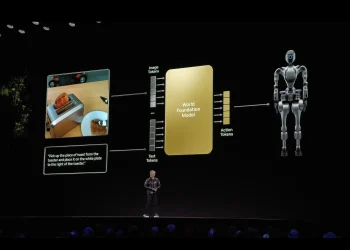
Even more stunning, Huang declared that physical, intelligent robots are already a reality. Within five years, he expects vision-language-action (VLA) models to function in real-world environments. These robots will understand instructions, interpret their surroundings, and take action—bridging the gap between code and physical labor.
In Huang’s world, AI becomes the backbone of both medicine and manufacturing. That makes Nvidia CEO AI policies critical not just for business, but for geopolitical power.
Risks and Realities: The Price of Progress
Despite optimism, Huang acknowledged the dangers of AI. From disinformation to bias, some harm is inevitable. Elon Musk’s chatbot Grok, which shared antisemitic content, is just one example.
Still, Huang urged society to be patient. He claims AI systems already use other AIs to fact-check outputs, and these tools improve daily. His core belief: even with flaws, AI will bring more good than harm.
However, observers have noted that Nvidia controls the AI infrastructure. They don’t just power this transformation—they define its rules. With their GPUs at the heart of global AI systems, they’ve become the gatekeeper.
A Gatekeeper for the AI Era
As Nvidia climbs past $4 trillion, it now shapes the AI-powered future. Whether it’s labor automation, healthcare advances, or intelligent robotics, Nvidia’s technology is behind it all. The world’s biggest companies—Microsoft, Meta, Google—build on Nvidia’s chips.
The AI gold rush may sound like progress, but some worry about consolidation and control. From Amazon to Facebook, we’ve seen how tech giants centralize power. Nvidia could be next.
Jensen Huang’s Nvidia CEO AI message is both hopeful and haunting. It promises cures and efficiency but demands caution. In the race to reinvent society with AI, Nvidia may have the final say—and the rest of us may have little choice.
You can also explore how Nvidia Shield TV is redefining entertainment at home via streaming and gaming:
https://www.nvidiarena.com/devices/tv/702/nvidia-shield-tv-redefines-streaming-and-gaming-at-home/
To understand Nvidia’s recent moves in China, including H20 GPU developments, read more here:
https://www.nvidiarena.com/news/744/nvidia-h20-china/
For a deeper look at CEO Jensen Huang’s bold AI vision and concerns, check out this detailed report by Gizmodo:
https://gizmodo.com/the-ceo-of-nvidia-admits-what-everybody-is-afraid-of-about-ai-2000628701