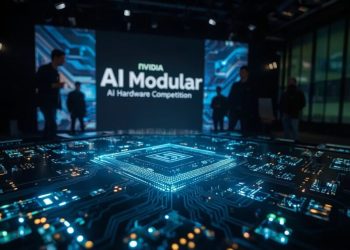
The NVIDIA Taipei AI supercomputer is trending as NVIDIA announces plans to build a massive AI factory supercomputer in Taipei, positioning Taiwan as a global hub for artificial intelligence innovation. For instance, unveiled on May 19, 2025, at Computex Taipei, the project aims to address labor shortages through AI and robotics, per Euronews. X posts highlight Taiwan’s strategic role, per @Reuters, amid Jensen Huang’s cultural ties to the region. Consequently, NVIDIA’s global influence grows. Thus, this article explores NVIDIA Taipei AI supercomputer, its scope, impacts, and why it’s driving clicks. Internal link: Global AI Trends
The Taipei Supercomputer
Project Scope
The NVIDIA Taipei AI supercomputer targets sovereign AI. Specifically, it will leverage NVIDIA’s Blackwell GPUs to power local AI development, per Euronews. Moreover, it supports Taiwan’s 10% GDP tech sector growth, per Bloomberg. As a result, innovation accelerates.
Strategic Ties
Furthermore, Taiwan partnerships amplify impact. For example, Taiwan Semiconductor Manufacturing (TSMC) adopts NVIDIA’s cuLitho software for chip production, per ZDNET. Additionally, Jensen Huang’s Taipei office expansion, dubbed NVIDIA Constellation, underscores commitment, per X posts. Therefore, collaboration deepens.
Impacts on NVIDIA and Taiwan
NVIDIA’s Leadership
The NVIDIA Taipei AI supercomputer solidifies NVIDIA’s dominance. For instance, it aligns with NVIDIA’s 82% AI chip market share, outpacing AMD’s 17%, per Silicon UK. Moreover, X posts note its Saudi AI deals, per @StockMKTNewz, boosting global reach. Thus, market power grows.
Taiwan’s Ecosystem
Moreover, it elevates Taiwan’s tech hub status. Specifically, the supercomputer could create 5,000 AI jobs, per Reuters. Additionally, Samsung’s HBM4 partnership shows regional tech synergy, per X posts. As a result, economic impact surges.
Challenges Facing the Project
Resource Demands
However, NVIDIA Taipei AI supercomputer faces supply constraints. For example, NVIDIA’s chip shortages persist, with Lepton service rationing demand, per ZDNET. Moreover, X posts cite TSMC’s production limits, per @bneintellinews. Therefore, scalability is a hurdle.
Geopolitical Risks
Another challenge is China tensions. Specifically, U.S. chip bans cost NVIDIA $15 billion in China sales, per Yahoo Finance. Furthermore, Taiwan’s boat arrests highlight regional volatility, per X posts. Consequently, stability is at risk.
The Future of NVIDIA’s Global Strategy
AI Expansion
Looking ahead, Taipei AI supercomputer will scale globally. For instance, similar projects are eyed for Saudi Arabia, per Yahoo Finance. Additionally, China’s Tiangong expansion shows competitive ambition, per X posts. Thus, reach expands.
Tech Influence
Furthermore, NVIDIA will shape AI ecosystems. For example, its model could inspire Japan’s tech initiatives, per Reuters. Moreover, Rocket Lab’s QPS-SAR-10 shows commercial parallels, per X posts. As a result, leadership strengthens.
In summary, Taipei AI supercomputer fuels Taiwan’s tech rise, captivating audiences with its geopolitical stakes.
Other News:
NVIDIA’s NVLink Fusion Redefines AI Infrastructure
China Expands Tiangong Space Station with New Modules