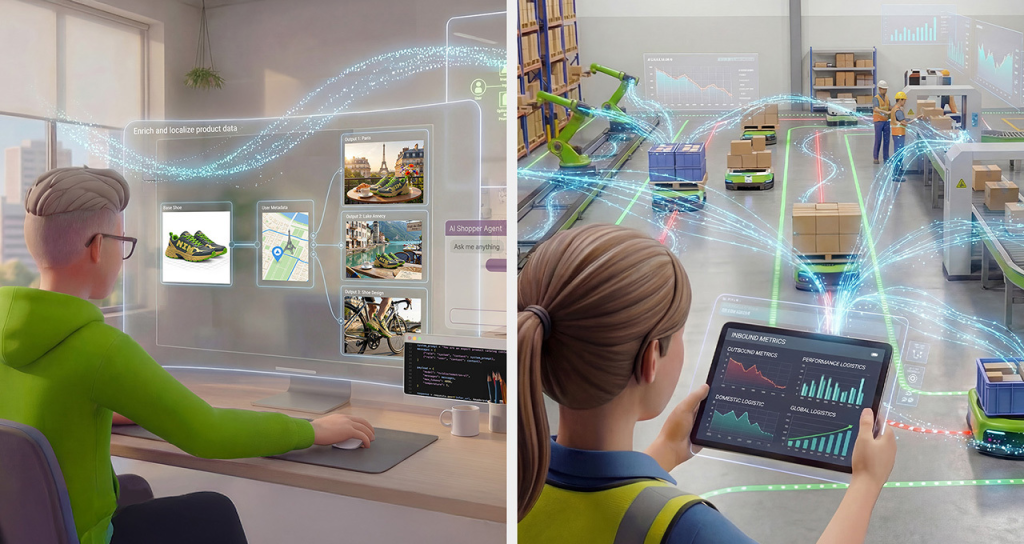
NVIDIA has introduced new AI-driven solutions aimed at enhancing retail operations. The Multi-Agent Intelligent Warehouse (MAIW) and Retail Catalog Enrichment AI blueprints are designed to address common challenges faced by businesses in the retail industry. These open-source developer references help streamline processes from warehouse management to product catalog creation, empowering developers to create custom AI solutions that fit into the retail value chain.
The new blueprints were announced this week and will be showcased at the National Retail Federation: Retail’s Big Show. The aim is to provide businesses with powerful tools that improve efficiency, reduce the cost of integration, and scale operations rapidly.
Transforming Warehouse Operations with AI
Warehouses are dynamic environments, where issues can arise unexpectedly—ranging from out-of-stock items to technology malfunctions. A major challenge in warehouse management is the disconnect between IT systems and operational technology (OT), which makes it difficult for managers to address problems efficiently. NVIDIA’s MAIW blueprint solves this issue by introducing a synchronized AI system that integrates with existing warehouse management systems, robotics, and IoT data.
The MAIW blueprint incorporates specialized AI agents for various functions such as equipment operations, safety compliance, task forecasting, and document processing. The central operational assistant, powered by AI, can analyze real-time data and offer actionable insights. For example, when a warehouse supervisor asks, “Why is packing slow?” the system analyzes equipment status, task queues, and staffing data, then suggests practical solutions to address the bottleneck.
This AI-driven system not only helps reduce operational friction but also provides production-grade capabilities, ensuring that AI-driven decisions align with company policies and safety protocols.
AI-Powered Retail Catalog Enrichment
Another significant development from NVIDIA is the Retail Catalog Enrichment blueprint, which aims to solve the issue of sparse product data that retailers often face. Retailers frequently deal with inconsistent or minimal product details, leading to time-consuming efforts to create accurate, localized product descriptions. The Retail Catalog Enrichment blueprint uses generative AI to automate the creation of high-quality product content at scale, ensuring consistency and accuracy.
For example, a home goods retailer can take basic photos of products like ceramic mugs and use NVIDIA’s Nemotron vision language model (VLM) to generate product metadata such as material, size, style, and usage recommendations. The AI system can also create localized titles and descriptions, optimized for SEO and geographically relevant marketing, as well as culturally appropriate images and 3D assets.
This blueprint reduces the burden of manual content creation and provides an efficient, scalable solution for global retailers who need to manage vast and constantly updating product catalogs.
Real-World Applications and Industry Impact
The new blueprints have already found practical applications, with companies like Grid Dynamics developing catalog management systems using the Retail Catalog Enrichment AI blueprint. By automating catalog data management, retailers can improve the accuracy of their product listings and enhance the customer shopping experience, leading to increased customer satisfaction and loyalty.
“The quality of search and browsing experiences for customers directly depends on the quality of catalog data,” says Ilya Katsov, CTO of Grid Dynamics. By using AI-driven business rules, Grid Dynamics helps brands optimize their product catalogs, ensuring they are more discoverable and better aligned with customer intent.
Reimagining the Retail Supply Chain with AI
The MAIW and Retail Catalog Enrichment AI blueprints are part of a broader initiative to integrate AI at every level of the retail supply chain. From backend inventory management to frontend customer experiences, NVIDIA is working to make the retail pipeline more intelligent and efficient.
The integration of these blueprints into retail operations allows businesses to manage inventory more proactively, create more accurate product listings, and provide a seamless shopping experience for consumers. As the retail sector continues to evolve, AI-driven solutions like NVIDIA’s blueprints will be essential for staying competitive in an increasingly fast-paced and data-driven market.
Future of AI in Retail Operations
Looking ahead, NVIDIA’s use of AI in retail continues to evolve, with plans to embed a physical AI layer in both warehouses and stores. This layer will enable intelligent agents to interact with real-world inventory, perform tasks autonomously, and address supply chain challenges in real-time.
“The next step is embedding a physical AI layer into warehouse and store operations, enabling intelligent agents to see, reason, and act on real-world inventory and supply-chain challenges,” said Tarik Hammadou, director of developer relations at NVIDIA. This development will further streamline operations, enhance decision-making, and optimize the overall retail pipeline.