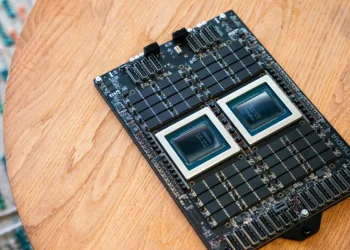
Nvidia is preparing to revolutionize the memory market with SOCAMM memory modules deployment. Consequently, the company plans to integrate between 600,000 and 800,000 units in 2025. Moreover, this initiative positions the technology as a potential successor to high-bandwidth memory systems.
Industry analysts believe this move could transform memory and substrate sectors significantly. Specifically, the deployment volumes appear modest compared to current HBM usage. Nevertheless, the strategic positioning suggests long-term market disruption potential.
Reports from ET News and Wccftech indicate Nvidia’s commitment to integration. Specifically, the company shared projected order quantities with key memory suppliers. Furthermore, the upcoming GB300 “Blackwell” platform will feature SOCAMM technology.
Additionally, Nvidia’s AI PC Digits, unveiled at GTC 2025, incorporates these advanced modules. However, Nvidia told DIGITIMES Asia that it has not confirmed these specific details. Nevertheless, the reported integration suggests serious development progress.
The deployment represents strategic positioning for next-generation AI products. Specifically, the technology addresses growing demands for high-performance computing solutions. Moreover, the modules complement existing HBM systems rather than immediate replacement.
Nvidia initially collaborated with Samsung Electronics, SK Hynix, and Micron on development. However, Micron emerged as the first manufacturer to receive volume production approval. Specifically, the company outpaced South Korean rivals in supporting Nvidia’s latest architectures.
Micron’s success stems from focused development and manufacturing capabilities. Furthermore, the company leveraged existing LPDDR DRAM expertise for production. Additionally, early approval positions Micron advantageously in the emerging market segment.
The design targets low-power, high-bandwidth AI computing applications. Specifically, the technology offers significant upgrades over conventional notebook DRAM modules. Moreover, LPCAMM comparisons highlight performance improvements in compact form factors.
Micron claims its modules deliver 2.5x increased bandwidth compared to traditional RDIMM modules. Furthermore, the technology reduces size and power consumption by one-third. Additionally, input/output speeds and data transfer rates exceed conventional alternatives.
The architecture maintains upgrade-friendly characteristics despite performance gains. Specifically, compact form factors support various computing environments. Moreover, low-power consumption addresses thermal management challenges in dense AI systems.
LPDDR DRAM foundation provides proven reliability for applications. Furthermore, the technology balances performance with energy efficiency requirements. Additionally, manufacturing scalability supports volume production demands.
Initial deployment focuses on AI servers and workstations. Specifically, enterprise applications drive early adoption patterns. Nevertheless, inclusion in consumer AI PC Digits signals broader market ambitions.
The crossover potential between enterprise and consumer markets proves crucial for adoption scaling. Furthermore, these modules bridge cost-effective memory solutions with AI performance demands. Additionally, the technology addresses diverse computing requirements across market segments.
While projected 600,000-800,000 units trail behind 9 million HBM units planned for 2025, analysts view the introduction as pivotal. Specifically, the technology represents an inflection point in memory market evolution. Moreover, performance characteristics appeal to cost-conscious AI developers.
The emergence reshapes substrate sector dynamics significantly. Specifically, the technology requires custom-designed PCBs for optimal performance. Furthermore, new demand categories create opportunities for substrate manufacturers.
Micron’s mass production capabilities establish early market presence. Nevertheless, Samsung and SK Hynix actively negotiate supply partnerships. Consequently, competition intensifies among top DRAM vendors for market share.
Substrate suppliers prepare for potential demand inflection points. Specifically, early volumes remain limited but growth projections appear promising. Moreover, large-scale orders could trigger fierce competition among PCB vendors. Additionally, adoption creates entirely new business categories.
Industry players anticipate technology scaling beyond initial projections. Specifically, successful AI server deployment could accelerate consumer market penetration. Furthermore, performance advantages over traditional memory systems support long-term adoption.
The market represents strategic positioning for memory manufacturers. Additionally, early mover advantages provide significant competitive benefits. Nevertheless, technological evolution requires continuous innovation and investment.
Nvidia’s strategy reflects broader industry trends toward specialized memory solutions. Specifically, AI computing demands drive next-generation memory development. Moreover, the technology addresses performance, power, and form factor requirements simultaneously.
In conclusion, deployment represents significant advancement in AI memory technology. Nvidia’s strategic positioning with Micron creates early market advantages. Moreover, the technology bridges performance gaps between traditional and specialized memory systems. Consequently, these innovations could reshape memory market dynamics in the coming years.
READ: Nvidia’s AI Boom Drives SK Hynix Profit Surge Despite Tariff Fears