AI drug discovery is entering a new phase as NVIDIA and Eli Lilly and Company unveil what their leaders describe as a blueprint for the future of biopharma innovation. The vision was shared during a high-profile fireside chat at the J.P. Morgan Healthcare Conference in San Francisco.
During the discussion, NVIDIA founder and CEO Jensen Huang and Lilly chair and CEO Dave Ricks announced a first-of-its-kind AI co-innovation lab designed to transform how medicines are discovered, developed, and brought to market.
The initiative signals a deeper convergence between advanced computing and pharmaceutical science, with both companies positioning AI as a foundational tool for tackling the complexity of human biology.
A New AI Co-Innovation Lab
The new lab will combine Lilly’s expertise in drug development with NVIDIA’s leadership in artificial intelligence and accelerated computing. Huang described the project as a place where top minds in biology and computer science can work together at unprecedented scale.
According to the companies, the lab will be based in the San Francisco Bay Area and will focus on modeling biological systems that have historically been too complex to simulate effectively. NVIDIA and Lilly plan to jointly invest up to $1 billion over five years in talent, infrastructure, and computing resources to support the effort.
Transforming the Drug Discovery Process
Ricks emphasized the painstaking nature of traditional drug discovery, describing each small-molecule breakthrough as a handcrafted achievement. He explained that AI drug discovery could shift the process from artisanal experimentation to a more repeatable and scalable engineering discipline.
By integrating AI models with laboratory experimentation, researchers will be able to simulate vast numbers of molecular possibilities, test them digitally, and rapidly narrow down promising candidates. This approach could significantly reduce development timelines and improve success rates.
Scientist-in-the-Loop Framework
The co-innovation lab will operate under a scientist-in-the-loop model, where computational “dry labs” and experimental “wet labs” continuously inform one another. AI systems will generate hypotheses and predictions, while real-world experiments validate and refine the models.
This continuous feedback loop is designed to allow machines to work around the clock, accelerating learning cycles and enabling faster iteration. Both leaders framed the model as essential for addressing diseases that remain difficult to treat with current methods.
Building on NVIDIA’s AI Infrastructure
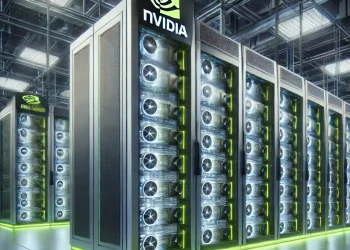
The lab builds on Lilly’s previously announced AI supercomputer, described as the most powerful AI factory in the biopharma industry. The system is powered by NVIDIA’s DGX SuperPOD with DGX B300 systems and is designed to train large-scale biomedical foundation models.
These models will support drug discovery, development, and clinical research, while also helping researchers identify new biological targets using AI-driven analysis.
A Broader Vision for Biopharma and AI
Huang and Ricks also reflected on Lilly’s long history of using computing in pharmaceutical research and highlighted diseases of the aging brain as a key frontier for future breakthroughs. Both leaders framed AI drug discovery as one of the most meaningful applications of modern computer science.
Beyond the lab announcement, NVIDIA used the J.P. Morgan Healthcare Conference to showcase advances across its AI biology ecosystem, including new tools and collaborations aimed at accelerating biomedical research.
As AI becomes more deeply embedded in drug development, the NVIDIA–Lilly partnership stands as a high-profile example of how technology and biopharma leaders are reshaping the future of medicine through shared innovation.