Japan AI Demand to Soar 320x by 2030
Japan’s artificial intelligence sector is heading toward massive expansion. Speaking at NVIDIA AI Day Tokyo, Kuniyoshi Suzuki, Senior Director of Cloud AI Service at SoftBank Corp, revealed that Japan AI demand for computing power will increase 320 times by 2030 compared to 2020.
Japan’s Drive Toward Sovereign AI
Over 900 participants attended the event to discuss sovereign AI—locally built and managed artificial intelligence systems. Suzuki stressed that Japan must develop domestic AI technologies, including large language models and national computing infrastructure, to support sustainable growth.
“To ensure safety and transparency as AI adoption expands, we must build Japan-made AI foundations,” Suzuki said. “This includes continuous model development powered by local innovation.”
Japan’s government has already pledged 10 trillion yen, about 65 billion US dollars, by 2030 to strengthen the semiconductor and AI industries.
Read Also
Partners Driving AI Expansion
NVIDIA Cloud Partners such as SoftBank, GMO Internet, and KDDI presented their progress in building AI factories and developer tools for large-scale model training.
Startups from NVIDIA Inception also unveiled projects using the NVIDIA NeMo software suite. Stockmark launched its 100-billion-parameter Japanese LLM as an NVIDIA NIM microservice, achieving 2.5x faster inference. FastLabel introduced a Data Curation solution for autonomous-driving systems, while Hakuhodo Technologies announced AI agents capable of autonomously producing advertisements.
Construction firm Shimizu Corporation shared how it is testing NVIDIA AI Blueprints to monitor work progress and safety through AI-powered video summarization.
Building Japan’s AI Ecosystem
A highlight of NVIDIA AI Day Tokyo was Nemotron-Personas-Japan, the first open synthetic dataset aligned with Japan’s demographics and culture. It supports the creation of regulation-ready foundation models without using sensitive personal data.
Bartley Richardson, NVIDIA’s Senior Director of Engineering, said Japan’s developers are building agentic AI systems capable of reasoning and collaboration. He noted that by using accelerated computing, Japan can create AI agents that maximize data and boost productivity.
Kazuya Ishikawa, AI evangelist at NEC, added that industry-focused AI solutions will transform Japan’s manufacturing, healthcare, and financial sectors. “LLMs such as NEC cotomi bridge knowledge gaps and improve efficiency across industries,” he said.
AI in Healthcare and Robotics
A special Japan Healthcare Day explored AI applications in medicine using NVIDIA Holoscan, Isaac for Healthcare, and MONAI. These tools accelerate medical imaging and digital health innovations.
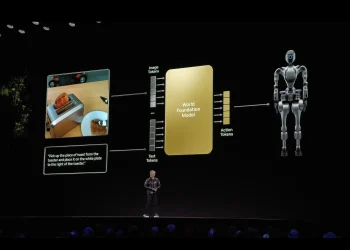
The Physical AI track showcased robotics and simulation tools, including NVIDIA Omniverse, Isaac GR00T for humanoid robotics, and Cosmos foundation models for real-world simulations.
What’s Next
Japan’s long-standing strength in engineering positions it to lead the next industrial revolution driven by AI. Agentic and physical AI systems are set to become digital coworkers capable of planning, reasoning, and executing complex tasks.
As Japan AI demand continues to rise, collaboration between government, industry, and academia will shape the nation’s sovereign AI future.
The next stop in NVIDIA’s global series will be AI Day Sydney on October 15–16, where innovators will explore new breakthroughs and build on Japan’s success story in the evolving AI landscape.