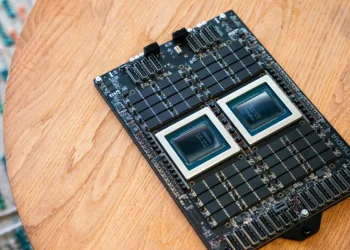
NVIDIA Q1 2025 earnings reached $44.1 billion, rising 12% from the prior quarter and 69% year-over-year. This impressive growth highlights NVIDIA’s dominance in the AI and data center markets. Notably, the data center segment brought in $39.1 billion in revenue. Much of this growth stems from increased global demand for AI infrastructure and inference capabilities. Moreover, the launch of NVIDIA’s Blackwell NVL72 AI supercomputer, now in full production, has further fueled demand. CEO Jensen Huang emphasized that countries increasingly view AI as essential infrastructure—similar to electricity and the internet. As a result, NVIDIA has positioned itself at the heart of a technological transformation.
Nevertheless, the company faced significant regulatory challenges. On April 9, 2025, the U.S. government began requiring licenses for exporting H20 products to China. Consequently, this new restriction impacted NVIDIA Q1 2025 earnings by triggering a $4.5 billion charge related to excess inventory and purchase obligations. Prior to this development, NVIDIA had secured $4.6 billion in H20 product sales. However, it was unable to fulfill an additional $2.5 billion in revenue due to the export ban. As a direct result, non-GAAP gross margins declined to 61.0%. Without this charge, they would have reached a more favorable 71.3%.
Despite these obstacles, NVIDIA maintained solid profitability. GAAP earnings per diluted share came in at $0.76, while non-GAAP earnings were slightly higher at $0.81. When excluding the $4.5 billion H20 charge and related tax impact, adjusted non-GAAP earnings per share would have reached $0.96. Clearly, these results reflect NVIDIA’s resilience and operational strength. Looking ahead, the company forecasts second-quarter revenue of $45.0 billion, plus or minus 2%. This outlook includes an expected $8.0 billion loss in H20 revenue due to the continued export restrictions. Furthermore, NVIDIA anticipates gross margins of 71.8% GAAP and 72.0% non-GAAP. The company aims to reach the mid-70% margin range by the end of fiscal 2026.
In addition to strong financials, NVIDIA is expanding its global AI footprint. The company is building AI factories across the U.S., Taiwan, Saudi Arabia, and the UAE. These efforts are designed to meet rising global demand while reducing supply chain risks. To support these projects, NVIDIA introduced key innovations like Blackwell Ultra, NVLink Fusion, and DGX SuperPOD. Additionally, cloud-based Blackwell instances are now available on AWS, Google Cloud, Microsoft Azure, and Oracle Cloud. In benchmark testing, the platform demonstrated up to 30x higher throughput, proving its real-world AI efficiency.
On the consumer side, NVIDIA’s gaming division posted record results. First-quarter gaming revenue reached $3.8 billion, representing a 48% jump from the previous quarter. This was largely driven by the launch of GeForce RTX 5070 and 5060, which deliver high performance at competitive prices. Furthermore, the Nintendo Switch 2 will feature NVIDIA chips with DLSS AI upscaling, enabling up to 4K resolution. DLSS 4 is now integrated into over 125 titles, including popular games like Star Wars Outlaws and Black Myth Wukong. Additionally, the RTX Remix modding platform has seen over 2 million gamers use it to enhance classic titles.

Meanwhile, the professional visualization segment brought in $509 million, up 19% from a year ago. Enterprise clients such as Siemens, SAP, and Accenture are integrating NVIDIA Omniverse into their platforms. This integration enables digital twin development, industrial automation, and AI-powered simulations. In the automotive and robotics sector, NVIDIA earned $567 million in revenue, reflecting a 72% year-over-year increase. Notably, the company partnered with General Motors to advance AI-driven vehicles and factory systems. At the same time, NVIDIA introduced several new robotics tools, including Isaac GR00T and Cosmos foundation models, aimed at speeding up development of humanoid and industrial robots.
In conclusion, NVIDIA Q1 2025 earnings showcase the company’s adaptability, innovation, and global leadership in AI. While regulatory hurdles affected short-term margins, NVIDIA’s forward-looking strategy, cutting-edge technology, and strong partnerships continue to drive growth. For further financial details, visit NVIDIA’s Investor Relations. To learn more about how AI is shaping the future, visit OpenAI Research.