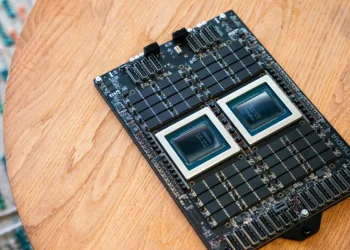
Nvidia AI Chip Demand is skyrocketing in 2025, propelling the company to new heights despite challenges from China export restrictions. Specifically, Nvidia’s first-quarter fiscal 2026 earnings reported $44.1 billion in revenue, a 69% year-over-year increase. Consequently, let’s explore how this demand shapes Nvidia’s global dominance.
Data Center Revenue Surge
The Nvidia AI Chip Demand primarily drives its data center business, which grew 73% year-over-year, generating $21.27 billion in Q1 revenue. For instance, major cloud providers like Microsoft Azure and Google Cloud account for nearly half of this revenue. Moreover, Nvidia’s Blackwell chips, designed for AI inference, meet the rising need for advanced AI applications. As a result, Nvidia solidifies its role as a key AI infrastructure provider.
Navigating China Export Restrictions
Despite Nvidia AI Chip Demand, U.S. export controls on H20 chips cost Nvidia $4.6 billion in Q1 sales to China, with an expected $8 billion hit in Q2. However, CEO Jensen Huang remains optimistic, noting strong global demand for Blackwell chips. For example, Nvidia plans to supply hundreds of thousands of GPUs to Saudi Arabia and the UAE for AI projects like Project Stargate. Consequently, these partnerships offset China losses.
Blackwell Chip Innovation
The AI Chip Demand centers on the new Blackwell chips, optimized for AI reasoning and inference. Specifically, these chips support applications like OpenAI’s ChatGPT, driving a tenfold surge in AI token generation. Moreover, Nvidia’s NVLink Fusion technology integrates non-Nvidia chips, broadening its ecosystem. As a result, Nvidia remains essential for AI development worldwide.
Global AI Infrastructure Expansion
Nvidia capitalizes on AI Chip Demand through international partnerships. For instance, the U.S. Department of Energy’s “Doudna” supercomputer, set for 2026, will use Nvidia’s Vera Rubin chips and Dell servers. Additionally, collaborations with Google Cloud enhance AI deployment on platforms like Vertex AI. Consequently, Nvidia powers national-scale AI initiatives globally.
Challenges and Competition
The AI Chip Demand faces competition from Chinese firms like DeepSeek, which develop advanced AI models using lower-tier chips. However, Nvidia counters this by innovating compliant chips for China. For example, Reuters reports Nvidia plans mass production of a new AI chip to meet restrictions. Furthermore, partnerships with TSMC for U.S. manufacturing bolster Nvidia’s supply chain. To learn more, visit Reuters Technology News. Explore our AI Infrastructure Guide or Nvidia Innovations.
In conclusion, Nvidia AI Chip Demand in 2025 drives unprecedented growth. By navigating challenges and innovating, Nvidia cements its leadership in the AI revolution.
Other News: