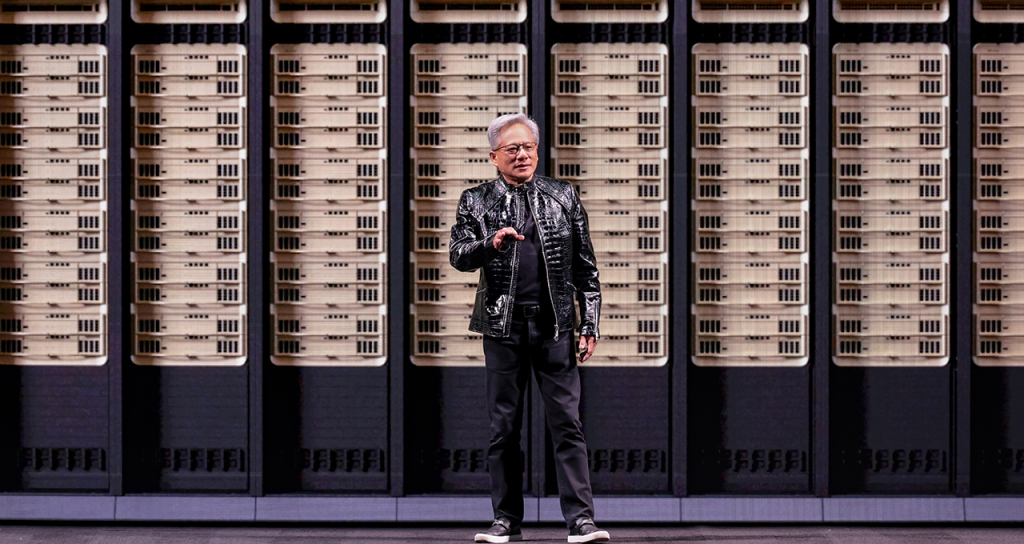
NVIDIA Rubin took center stage at CES as NVIDIA laid out an ambitious blueprint for the future of artificial intelligence, computing, and autonomous systems. Opening CES 2026 in Las Vegas, NVIDIA founder and CEO Jensen Huang declared that AI is now scaling across every industry, device, and physical environment.
Speaking at the Fontainebleau Las Vegas, Huang argued that accelerated computing and AI have fundamentally reshaped the technology landscape. He said trillions of dollars’ worth of traditional computing from the past decade are now being modernized through AI-driven architectures.
At the center of this shift is Rubin, NVIDIA’s first extreme-codesigned AI platform, alongside new open models for healthcare, robotics, climate science, and autonomous driving. The announcements underscored NVIDIA’s push to make AI more powerful, more efficient, and more accessible across industries.
Rubin Platform Redefines AI Infrastructure
Named after pioneering astronomer Vera Rubin, the NVIDIA Rubin platform succeeds the Blackwell architecture and marks the company’s first six-chip, extreme-codesigned AI system now in full production. The platform is built from the data center outward, integrating every layer of the stack to eliminate bottlenecks and lower costs.
Rubin combines next-generation GPUs delivering up to 50 petaflops of inference performance, Vera CPUs optimized for data movement and agentic processing, NVLink 6 networking, Spectrum-X Ethernet Photonics, ConnectX-9 SuperNICs, and BlueField-4 DPUs. Huang emphasized that designing these components together is essential to scaling AI to gigascale levels.
NVIDIA also introduced AI-native storage through its Inference Context Memory Storage Platform, a KV-cache tier designed to improve long-context inference. According to Huang, the full Rubin platform can reduce the cost of generating AI tokens to roughly one-tenth of previous systems, significantly improving performance per dollar and power efficiency.
Open Models Across Every Domain
Beyond hardware, NVIDIA highlighted its expanding portfolio of open AI models trained on NVIDIA supercomputers. These models are designed to support innovation across healthcare, climate science, robotics, embodied intelligence, and autonomous driving.
The open model lineup includes Clara for healthcare, Earth-2 for climate modeling, Nemotron for reasoning and multimodal AI, Cosmos for robotics and simulation, GR00T for embodied intelligence, and Alpamayo for autonomous vehicles. Huang described NVIDIA as a frontier AI model builder committed to openness, allowing developers to create, evaluate, guardrail, and deploy models freely.
He noted that rapid model iteration is driving explosive adoption, with new models emerging every six months and download volumes rising sharply as organizations integrate AI into real-world workflows.
AI-Defined Driving and Physical AI
Autonomous driving featured prominently in NVIDIA’s CES presentation. Huang unveiled Alpamayo, an open portfolio of reasoning vision-language-action models and simulation tools designed to enable level 4 autonomy. Alpamayo R1, the first open reasoning VLA model for autonomous driving, was demonstrated navigating complex urban traffic scenarios.
NVIDIA announced that the first passenger vehicle featuring Alpamayo on the NVIDIA DRIVE full-stack autonomous platform will debut in the all-new Mercedes-Benz CLA. AI-defined driving is expected to reach U.S. roads this year, following the model’s recent five-star EuroNCAP safety rating.
Huang also highlighted the growing adoption of DRIVE Hyperion, NVIDIA’s open, modular autonomous vehicle platform used by automakers, suppliers, and robotaxi developers worldwide.
AI From the Data Center to the Desktop
Huang stressed that AI’s future is both massive and personal. He demonstrated personalized AI agents running locally on NVIDIA DGX Spark desktop systems, paired with robotics powered by open models. These demos illustrated how AI agents can operate locally, respond in real time, and interact with the physical world.
NVIDIA also announced performance gains for DGX Spark, expanded support for generative image models, and upcoming availability of NVIDIA AI Enterprise. Enterprise partners cited during the keynote included Palantir, ServiceNow, Snowflake, CrowdStrike, NetApp, and others integrating NVIDIA’s full-stack AI into their platforms.
Building the Next Era of Computing
Throughout the presentation, Huang emphasized that delivering AI breakthroughs now requires complete system-level optimization. NVIDIA’s strategy centers on building the full stack, from chips and networking to software and models, so developers can focus on creating applications.
The CES keynote closed with updates across gaming, creation, and display technologies, including DLSS 4.5, expanded RTX Remix capabilities, NVIDIA ACE for in-game AI assistants, and new G-SYNC Pulsar displays.
With the NVIDIA Rubin platform, open models, and AI-defined autonomy, NVIDIA positioned itself not just as a chipmaker, but as a systems company shaping the future of intelligence across digital and physical worlds.