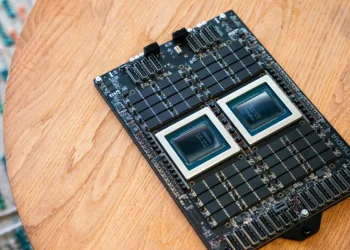
The Nvidia H20 chip export restrictions have shaken the global semiconductor landscape, with the US government placing new limits on AI chip shipments to China. The move, announced on April 15, adds to Washington’s growing list of sanctions aimed at curbing China’s access to cutting-edge technology with potential military applications.
On Monday, the Trump Administration informed Nvidia that it would now require an export licence to sell its China-focused H20 chip. Designed specifically for artificial intelligence use in China, the H20 had become Nvidia’s only chip legally permitted for that market following previous rounds of export controls.
The latest clampdown stems from U.S. concerns that H20 chips could support Chinese supercomputers and military technologies, including hypersonic weapons and nuclear advancements. The U.S. Commerce Department later confirmed that the new export controls also apply to AMD’s MI308 and similar chips to “safeguard national and economic security.”
$18 Billion in Orders at Risk
Nvidia had secured an estimated $18 billion in H20 orders since the beginning of the year. Yet, according to insiders, major Chinese cloud providers—including Tencent, Alibaba, and ByteDance—were unaware of the impending restrictions. This communication gap has sparked criticism, with claims that Nvidia failed to alert some customers in advance, despite reportedly being notified by U.S. officials as early as April 9.
The news triggered a 6% drop in Nvidia’s share price in after-hours trading on Tuesday. The company also warned that it expects to take up to $5.5 billion in charges for the first fiscal quarter, ending April 27. These charges are linked to H20-related inventory and purchase commitments that are now in jeopardy.
China Sales Threatened, Huawei Poised to Benefit
China remains one of Nvidia’s largest markets, generating $17 billion—or 13% of total revenue—in the fiscal year that ended January 26. The new restrictions could push Chinese firms toward domestic alternatives, especially Huawei.
“By restricting the H20 system, US regulators are effectively pushing Nvidia’s Chinese customers toward Huawei’s AI chips,” said Nori Chiou of White Oak Capital Partners. He added that Huawei’s software and chip design capabilities are likely to accelerate due to increased demand and customer feedback.
Chinese AI chipmakers had already begun ramping up efforts to fill the gap. Analysts believe the latest restrictions could give them the momentum to catch up, especially in AI-focused cloud services.
Nvidia Responds by Expanding US-Based AI Production
In parallel, Nvidia announced plans to build up to $500 billion worth of AI infrastructure in the United States over the next four years. The company aims to expand manufacturing capacity to support its booming AI chip segment while minimizing reliance on foreign production.
CEO Jensen Huang recently visited Trump’s Mar-a-Lago resort and is said to be supportive of reshoring efforts. Production of Nvidia’s new Blackwell GPUs has already begun at TSMC’s facility in Phoenix, Arizona. Additionally, Nvidia is building new plants in partnership with Foxconn in Houston and Wistron in Dallas, with mass production expected to ramp up in the next 12 to 15 months.
“Expanding in the U.S. allows us to better meet the demand for AI chips, strengthen our supply chain, and build resilience,” Huang said.
The White House praised Nvidia’s decision, calling it proof of “the Trump Effect in action.”
Conclusion
The Nvidia H20 chip export restrictions signal a major shift in tech trade dynamics between the US and China. While the move may protect U.S. national security, it also risks alienating one of Nvidia’s largest markets. As tensions escalate, Nvidia and other semiconductor giants are being forced to rebalance their global strategies—bringing high-tech manufacturing back to U.S. soil, while watching rivals like Huawei seize opportunities left in the vacuum.