NVIDIA Cosmos Reason teaches AI to reason
The NVIDIA Cosmos Reason model is designed to help AI think more like humans by learning physical common sense. While AI systems are advancing rapidly, they often lack the basic understanding that people gain from real-world experiences — such as knowing that mirrors reflect or that ice melts into water.
To solve this gap, NVIDIA developed a process for teaching AI models how to reason about physical environments. These methods are fueling breakthroughs in robotics, autonomous vehicles, and smart systems where machines must predict outcomes and act safely.
Human data powers physical AI
At the center of this innovation is NVIDIA’s data factory team. This global group curates video data, creates question-and-answer sets, and trains AI to recognize everyday physical rules. Annotators provide multiple-choice questions based on real-world clips, such as cars driving on a road or chickens walking in a coop.
The model must select the correct answer, and reinforcement learning helps refine its reasoning over time. Analysts then check each dataset for quality before it is passed to researchers. This human-guided process ensures accuracy and reliability.
Read Also
How reasoning improves AI performance
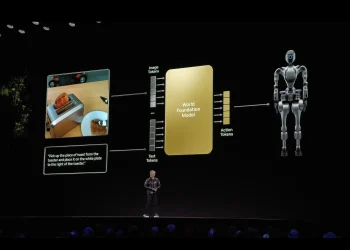
Reasoning AI is different because it can analyze a situation, explore possible outcomes, and explain its logic. For example, when asked what happens if two cars drive toward each other in the same lane, the model can reason and predict a crash. Unlike traditional AI, it does not just guess; it shows the logic behind the response.
This makes NVIDIA Cosmos Reason highly valuable for applications in safety-critical fields. Robots, autonomous vehicles, and industrial systems must all understand spatial and temporal rules to avoid accidents and interact effectively with humans.
Building the next generation of AI
NVIDIA researchers highlight that teaching common sense to AI reduces risks. Without these capabilities, robots might fall, break objects, or cause hazards. With reinforcement learning and carefully built datasets, AI can navigate complex environments more safely.
As Tsung-Yi Lin, a lead scientist on the project, explained, the team is “building a pioneering reasoning model focused on physical AI.” With strong data curation and model design, NVIDIA is shaping the future of intelligent agents capable of safe and reliable real-world interaction.
The progress of NVIDIA Cosmos Reason shows how human knowledge and AI innovation can combine to create smarter, safer systems. It also signals a broader shift in AI development: embedding humanlike reasoning into models that will soon power robotics, transportation, and industrial automation worldwide.