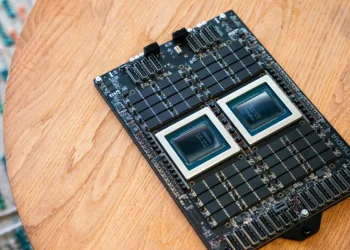
NVIDIA China Strategy in 2025 demonstrates resilience as the company navigates stringent U.S. export controls impacting its AI chip sales. Specifically, NVIDIA introduces a new Blackwell-based chip for China, priced competitively, to maintain its foothold in a market that accounted for 13% of its 2024 revenue. Consequently, let’s examine how NVIDIA adapts to sustain growth in Asia.
New Blackwell Chip for China
The NVIDIA China Strategy centers on a cost-effective Blackwell chip tailored for China. For instance, priced at $6,500–$8,000, this chip uses conventional memory, avoiding TSMC’s advanced packaging to comply with U.S. restrictions. Moreover, mass production begins in June 2025, targeting Chinese tech firms like Huawei and Baidu. As a result, NVIDIA aims to recapture lost market share amid a $8 billion Q2 revenue hit from export curbs.
Impact of Export Controls
U.S. export controls challenge NVIDIA China Strategy significantly. Specifically, restrictions on H20 chips, effective April 9, 2025, result in a $4.5 billion Q1 charge and $2.5 billion in lost Q1 sales. Additionally, CEO Jensen Huang estimates a $15 billion total sales loss due to these rules. However, NVIDIA repurposes H20 materials, reducing the charge from $5.5 billion, showcasing operational agility. Consequently, the company mitigates financial impacts.
China’s Shift to Domestic Chips
The NVIDIA China Strategy faces competition as Chinese firms pivot to homegrown chips. For example, companies like Huawei develop alternatives due to dwindling NVIDIA stockpiles, spurred by tightening export controls. Nevertheless, NVIDIA’s brand and performance edge keep it relevant, with Chinese customers stockpiling chips before curbs tightened. As a result, NVIDIA retains influence despite local competition.
Strategic Market Diversification
To bolster NVIDIA China Strategy, NVIDIA diversifies into other Asian markets. For instance, demand in Japan and South Korea grows, with firms like Tokyo Electron and SK Hynix rallying after NVIDIA’s Q1 earnings. Moreover, partnerships with Taiwanese manufacturers ensure supply chain stability. Consequently, NVIDIA offsets China losses with robust growth in Asia-Pacific, sustaining 69% revenue growth in Q1 2025.
Future Outlook
Looking ahead, NVIDIA China Strategy aims to deepen Asia’s AI ecosystem. For example, NVIDIA explores joint ventures with Chinese firms to comply with regulations, while expanding Blackwell chip production globally. Additionally, Huang’s advocacy for balanced export policies may influence U.S. trade decisions. To learn more, visit Reuters Technology at their website (https://www.reuters.com). Explore our NVIDIA Strategy Guide or China Tech Trends.
In conclusion, China Strategy in 2025 navigates export curbs with innovative chips and diversification. By adapting swiftly, NVIDIA maintains its leadership in Asia’s AI market.
Other News: How NVIDIA Powers AI Factories Through Token Processing
Canadian Quantum Computing Pioneers Global Breakthroughs