Nvidia $500B U.S. AI infrastructure plan marks one of the largest tech manufacturing pledges in recent years. The chipmaker announced on Monday that it will invest up to $500 billion over the next four years to build AI infrastructure across the United States.
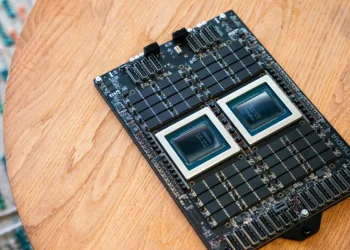
The plan includes Blackwell AI chip production at TSMC’s Arizona factory and supercomputer assembly plants in Texas, operated by partners Foxconn and Wistron. These facilities are expected to become fully operational within 12 to 15 months, according to Nvidia.
This initiative aligns Nvidia with a growing list of tech giants responding to the Trump administration’s push for reshoring advanced manufacturing. With the looming threat of steep U.S. tariffs, companies like Apple have already committed large-scale investments. Apple recently pledged $500 billion toward U.S. projects, including AI server factories in Texas.
Nvidia CEO Jensen Huang emphasized the importance of producing locally. “Adding American manufacturing helps us better meet the incredible and growing demand for AI chips and supercomputers,” he said. “It strengthens our supply chain and boosts our resiliency.”
Most of Nvidia’s processors are currently made in Taiwan. However, this move signals a significant shift toward domestic production. Huang had earlier stated that Nvidia expects minimal short-term impact from tariffs but plans to localize manufacturing over time.
On Monday, Nvidia confirmed that TSMC has already started producing Blackwell chips at its Arizona site.
TSMC, the world’s largest contract chipmaker, has committed to a separate $100 billion investment in the U.S. The company plans to build five new semiconductor plants, further reinforcing its long-term presence in the country.
Nvidia’s U.S. infrastructure strategy not only supports national interests but also promises significant economic impact. The company stated that AI chip and supercomputer manufacturing will create hundreds of thousands of jobs in the coming decades.
The Nvidia $500B U.S. AI infrastructure plan signals a broader shift in the global tech supply chain. With AI demand surging and geopolitical pressures rising, local production is becoming a key pillar in future-proofing the industry.