Google has escalated the battle for artificial intelligence supremacy by introducing a new generation of custom chips aimed at challenging Nvidia’s dominance in the market. The announcement marks a significant shift as major tech companies race to control the infrastructure powering the global AI boom.
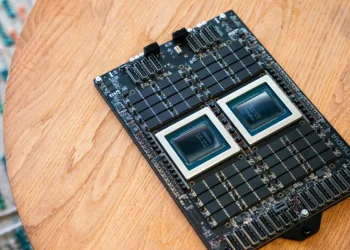
At its Cloud Next conference in Las Vegas, Google unveiled its latest Tensor Processing Units, known as TPU 8t and TPU 8i. These new Google AI chips are designed to handle both training and inference workloads, putting them in direct competition with Nvidia’s widely used GPUs.
The development signals Google’s growing ambition to reduce reliance on third-party chipmakers. Instead, the company is investing heavily in building its own hardware ecosystem to support its expanding AI services and cloud platform.
According to Google’s chief scientist Jeff Dean, the company is now focusing on specialized chip designs. He explained that it has become more practical to tailor chips specifically for training or inference tasks, rather than relying on a one-size-fits-all approach.
This strategy directly challenges Nvidia’s long-standing position. Nvidia CEO Jensen Huang has argued that GPUs remain more versatile, supporting a broader range of applications than Google’s TPUs. However, Google’s latest moves suggest that specialization could deliver greater efficiency and lower costs.
The competition is already reshaping the AI landscape. Companies such as Anthropic have secured access to up to one million Google TPUs to power their AI models. Meanwhile, Meta Platforms has signed a multibillion-dollar agreement to use these chips through Google Cloud.
Beyond its in-house chips, Google is also expanding its strategy through partnerships. The company is working with Marvell Technology to develop two new AI chips, including a Memory Processing Unit designed to address data bottlenecks and a next-generation inference-focused TPU.
The inference chip represents a major shift in design philosophy. Unlike previous versions that handled both training and inference, this new model focuses exclusively on inference tasks. This specialization could improve energy efficiency and reduce costs, making AI deployment more scalable.
Production plans further highlight Google’s aggressive push. The new chips are expected to enter mass production in the third quarter of 2026 using advanced 3-nanometer manufacturing technology. Shipments could grow by more than 40 percent this year, outpacing other cloud providers.
This rapid expansion reflects the increasing importance of AI infrastructure. As demand for AI services grows, control over hardware has become a strategic priority. Companies that design their own chips can optimize performance, reduce costs, and maintain tighter control over their technology stack.
The Google AI chips initiative also underscores a broader trend in the tech industry. Major firms are moving away from dependence on external suppliers and toward vertically integrated systems that combine hardware, software, and cloud services.
For Nvidia, the challenge is significant but not unexpected. The company has long dominated the AI chip market, but rising competition from tech giants could reshape the industry in the coming years.
As the race intensifies, the outcome will likely define the future of artificial intelligence. The battle between Google AI chips and Nvidia’s GPUs is not just about hardware. It is about who controls the foundation of the next generation of computing.